
In short. Most Dutch tax changes for 2027 take effect on 1 January 2027, which is also the box 3 reference date. Expats who still have partial non-resident status under the 30% ruling lose it on 31 December 2026, and the ruling itself falls to 27% for most employees. Box 3 is set to become more expensive in 2027, so private individuals should review their position, including foreign assets. Director-shareholders can save tax by spreading dividends over 2026 and 2027. Employers should check company cars, the work-related costs scheme and Wtta registration before year-end.
Contents
What should you arrange before year-end?
Discuss which year-end tax tips apply to your situation with Port Sight Tax.
Book a consultation
This overview covers the Dutch Tax Plan 2027 (Belastingplan 2027), the additional box 2 and box 3 proposals of 29 September 2026, and changes enacted earlier that take effect on 1 January 2027, such as the reduction of the 30% ruling to 27%. That date is also the box 3 reference date (peildatum), and it is the day the transitional rule for partial non-resident status ends. Some decisions should therefore be taken before the end of 2026, while others are better postponed until 2027.
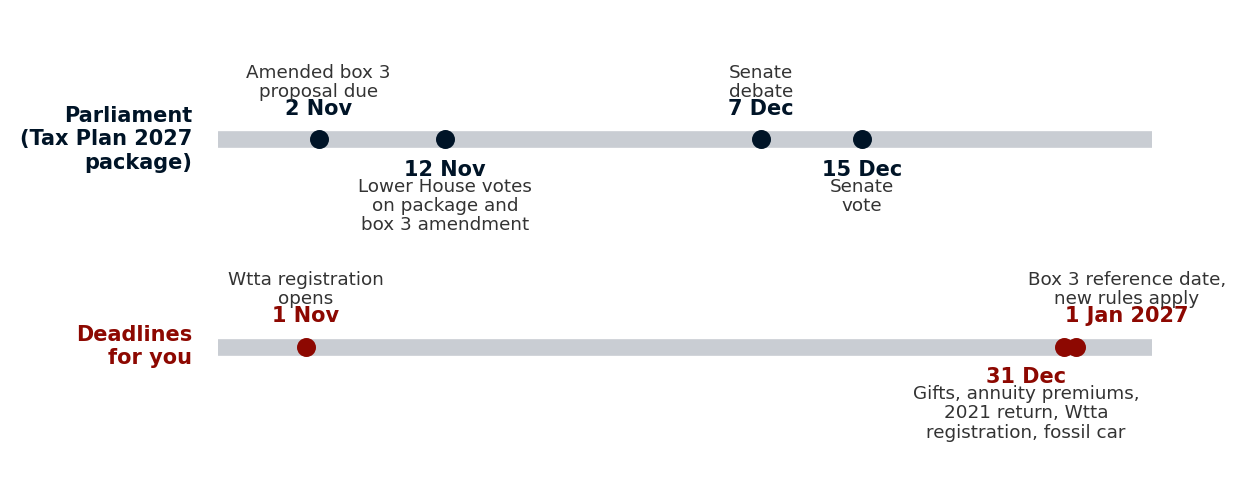
The Tax Plan 2027 was presented on 15 September 2026. On 29 September the cabinet announced further changes to box 2 and box 3. These are not part of the Tax Plan itself but of an amendment to the pending box 3 bill, which the cabinet intends to submit by 2 November. The Lower House votes on 12 November, and the Senate debates the package on 7 December and is scheduled to vote on 15 December. The proposals described below can still change, the box 3 measures in particular.
Internationals and expats
1. 30% ruling: partial non-resident status ends on 31 December 2026
Employees who applied the 30% ruling in the December 2023 payroll could continue to opt for partial non-resident status (partiële buitenlandse belastingplicht) in 2025 and 2026 under transitional rules. These rules end on 31 December 2026. From 2027 these taxpayers are subject to box 3 tax on their worldwide savings and investments and to box 2 tax on shareholdings of 5% or more in foreign companies.
For many of them, 1 January 2027 will be the first box 3 reference date, at the same time as the lower allowance and higher deemed return described in point 3. Foreign bank and investment accounts, real estate in the home country and interests in family companies are then included in box 3 or box 2. For foreign real estate, relief for double taxation is generally available. For foreign portfolio investments it generally is not.
We recommend preparing an overview of all foreign assets and debts with their euro values on 1 January 2027, and having shareholdings of 5% or more valued at the same date. According to the published position of the tax authorities, the acquisition price of a foreign substantial shareholding is set at its market value at the moment partial non-resident status ends, so a well-supported valuation as of that date reduces the taxable gain on a later sale. Foreign pension accounts, such as US 401(k) plans and IRAs, should be reviewed separately, as not all foreign pension arrangements are exempt in box 3.
From practice: Many clients with partial non-resident status never needed a valuation of their foreign holdings, because those holdings were outside Dutch tax. Shares in a family company abroad or a US corporation then have no documented value at the end of 2026. A valuation prepared now, as of the date the status ends, is far easier to support than a reconstruction years later when the shares are sold. A discounted cash flow (DCF) valuation is often sufficient. For some companies another method is more appropriate, for example a net asset value approach for a holding or real estate company, or a valuation based on comparable transactions for a start-up without stable cash flows.
2. The 30% ruling becomes 27% from 2027
From 1 January 2027 the maximum tax-free allowance under the expat ruling (30%-regeling) is reduced from 30% to 27% of the capped salary. Employees for whom the ruling was applied in 2023 or earlier keep 30% for the remaining term. For employees who started in 2024 or later, 27% applies from the January 2027 payroll. Employees who started in 2024 keep the current salary threshold. For employees who started in 2025 or 2026, the higher salary threshold applies from 2027, so some of them may no longer qualify. The higher threshold also applies to all new rulings from 2027.
Employers should check the start year per employee in the payroll administration before the January payroll and inform the employees concerned in December. Where an employment contract provides for a fixed net salary, the cost of the reduction is borne by the employer.
Private wealth and box 3
3. Box 3 in 2027: tax-free allowance and deemed return on 1 January
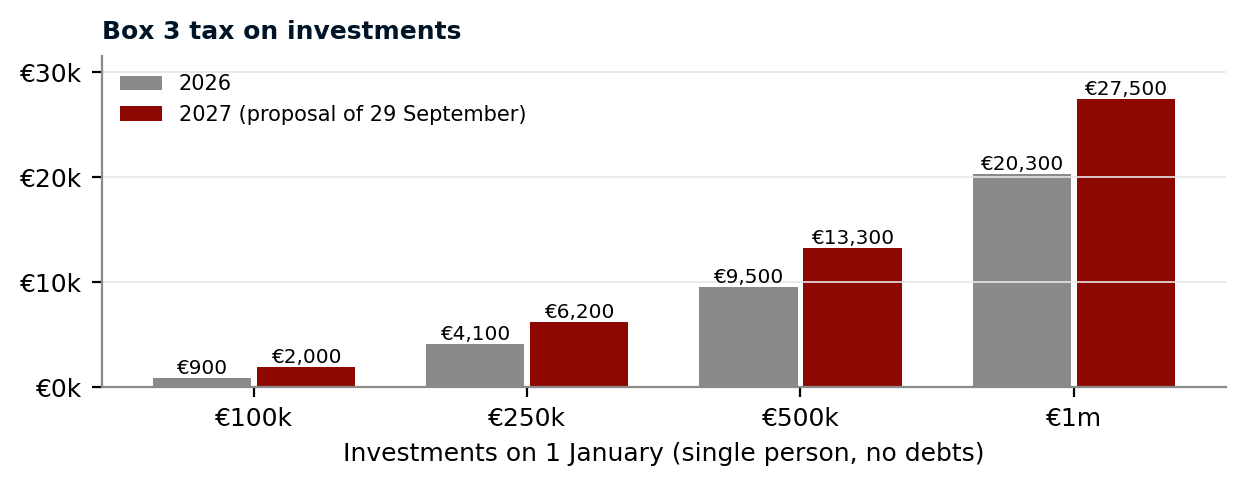
On Budget Day the 2027 figures were a tax-free allowance of €60,098 per person and a deemed return on other assets (such as shares, bonds, second homes and receivables) of 6.37%. The proposals of 29 September reduce the allowance to €30,846 per person and increase the deemed return on other assets by 1.5 percentage points to 7.87%. The rate remains 36%. The finance minister has said the allowance will not stay at €30,846, and the cabinet is working on alternative funding.
For a single person with €500,000 in investments and no debts, the box 3 tax would increase from about €9,500 for 2026 to about €13,300 for 2027 under the 29 September proposals.
Foreign bank and investment accounts count in box 3 at their value in euros on 1 January, so the exchange rate on that date also affects the tax.
From practice: For US expats, retirement accounts are the most frequent box 3 question. A 401(k) or a traditional IRA is often treated differently from a Roth IRA, and for a Roth IRA the Dutch treatment depends on the features of the account and on the US-Netherlands tax treaty. Where the amounts are substantial, it is worth establishing the position before the first box 3 return is filed, if necessary through advance consultation with the tax authorities.
Temporarily moving investments to a bank account around 1 January has no effect. If investments are sold before and repurchased after 1 January within a period of three months, the transactions are disregarded unless there is a non-tax reason for them. Actual changes in the composition of assets, such as expenditure, gifts or a purchase that takes place after 1 January (point 5), are taken into account.
The box 3 exemption for green investments is reduced from €26,715 per person to €200 in 2027 and abolished in 2028. Green investments held mainly because of the exemption should be reviewed, as their return is often lower.
4. Box 3 actual return for 2026 and the new system from 2028
For 2026 it is still possible to show that the actual return was lower than the deemed return. The actual return includes interest, dividends, rental income and all changes in value, including unrealized gains. This may be relevant for portfolios with a poor return, large bank balances and real estate without an increase in value. Costs are not deductible under this method, and the tax-free allowance does not apply. Complete information is required: values on 1 January and 31 December, all income, and currency results on assets in foreign currency. We recommend requesting annual statements from all banks and brokers, including foreign ones, at an early stage.
From 2028 the cabinet intends to tax box 3 on the basis of actual returns. Under the proposals, real estate and, following the September changes, shares, bonds and options would only be taxed on gains upon sale. Under the draft amendment, the acquisition price of assets already held on 1 January 2028 is their market value on that date (for homes, the WOZ value). Gains that arose before 2028 would therefore not be taxed under the new system, so there is no tax reason to sell investments before that date. Losses incurred before 2028 cannot be offset either. Crypto assets and other assets would be taxed annually on changes in value in 2028 and 2029. Banks will not provide data for the pre-filled return for 2028, so taxpayers will need to keep their own records from 1 January 2028.
5. Buying a rental property or second home: transfer tax proposed at 7% from 2027
It is proposed to reduce the transfer tax (overdrachtsbelasting) rate for homes that the buyer will not use as main residence, such as rental properties, second homes and holiday homes, from 8% to 7% as of 1 January 2027. On a purchase price of €600,000, this saves €6,000.
If the transfer takes place in January, the property is also not part of the buyer’s box 3 assets on 1 January 2027. On that date the purchase price is still held in a bank account, to which a much lower deemed return applies. The rate for commercial property remains 10.4% and the 2% rate for a main residence does not change. Whether the transfer date can be moved depends on the purchase agreement. The purchase price, financing and availability of the property will usually be more important than the difference in rate.
6. Gifts before 31 December 2026: exemptions and the box 3 effect
Gifts made in 2026 fall under the 2026 exemptions and reduce the donor’s box 3 assets on 1 January 2027. In 2026 parents can give each child €6,908 free of gift tax (schenkbelasting). A one-off increased exemption of €33,129 applies to children aged 18 to 40, or €69,009 if the gift is used for an expensive study, subject to conditions.
With a lower tax-free allowance, gifts to adult children with limited box 3 assets of their own lead to a larger box 3 saving than before, as each child has their own allowance. A gift tax return must be filed for the one-off increased exemption, even if no gift tax is due. Gift and inheritance tax rates remain unchanged in 2027.
Dutch gift tax applies when the donor lives in the Netherlands. A donor who has left the Netherlands is treated as a resident for another ten years if they have Dutch nationality, and for one year otherwise.
Director-shareholders
7. Dividend in 2026 or 2027? The proposed box 2 rate cut
In box 2, income up to €68,843 per person is taxed at 24.5% in 2026 and income above that amount at 31%. Each fiscal partner has a separate first bracket. It is proposed to reduce the 31% rate to 29.2% for the years 2027 to 2030. The first bracket for 2027 is €69,703 according to the corrected key figures table.
It is therefore generally advantageous to distribute a dividend up to the first bracket in 2026 and any further amount in 2027. For a single shareholder, a dividend of €200,000 in 2026 results in about €57,500 of tax. If €68,843 is distributed in 2026 and €131,157 in 2027, the total tax is about €51,900. Of the difference of about €5,600, approximately €1,100 results from the rate reduction and the remainder from using the first bracket twice.

A larger dividend in 2026 may still be appropriate if it is needed to reduce debts to the BV below the limit (point 8) or to pay a private expense before 1 January. A dividend still held in a private bank account on 1 January 2027 is included in box 3.
8. Excessive borrowing from your own BV: the limit falls from 2027
Debts to your own BV above €500,000 are taxed in box 2 as a deemed dividend under the excessive borrowing rules (excessief lenen). The test is applied on 31 December, and the debts of the shareholder and their fiscal partner are added together. It is proposed to reduce the limit by €80,000 per year, to €420,000 on 31 December 2027 and to €100,000 in 2031. Owner-occupied home loans remain outside the limit, provided loans entered into from 2023 onwards are secured by a mortgage right.

The limit of €500,000 still applies on 31 December 2026. Shareholders with debts above €420,000 have until the end of 2027 to reduce them, for example by repayment, a dividend within the first bracket, or set-off against salary or other receivables. Where the debt has to be reduced over several years, dividends in 2027 to 2030 benefit from the lower rate.
9. Selling your company, liquidating or leaving the Netherlands
The proposed 29.2% rate applies to all box 2 income in the second bracket, including capital gains on the sale of shares and liquidation distributions. A gain realized in 2027 to 2030 would be taxed at a rate 1.8 percentage points lower than in 2026, which amounts to about €35,000 on a gain of €2 million. If a sale is expected to close in December, consider moving closing to January.
The same applies to emigration. A substantial shareholder who emigrates receives a protective assessment (conserverende aanslag) on the latent gain, calculated at the rate applicable in the year of emigration. If emigration is planned around the turn of the year, the effect of the date should be calculated in advance, including the box 3 position on 1 January and the treaty position in the new country of residence.
From practice: The protective assessment requires a valuation of the shares at the moment of departure. That valuation is most easily prepared together with the year-end figures of the BV, so a departure planned for early 2027 is best discussed before the books for 2026 are closed. A DCF valuation is often sufficient for this purpose, but for a holding or real estate company, for example, a net asset value approach may be more appropriate.
Employers and Dutch companies
10. Company cars: the 12% charge on fossil-fuel cars from 2027
From 2027 employers would pay a 12% charge on the list price of a passenger car with CO2 emissions that is also used privately. This charge is payable in addition to the taxable benefit for the employee and cannot be recovered from the employee. For this charge, commuting is treated as private use. The charge also applies to a director-shareholder who drives a company car of their own BV. Vans are not affected.
Cars made available to an employee before 1 January 2027 fall under transitional rules until 17 September 2030. The cabinet has proposed to extend this to the end of 2030. The car keeps this status if it is later made available to another employee of the same employer. If a fossil-fuel car is going to be provided in any case, doing so before the end of 2026 avoids the charge for the transitional period.
11. Work-related costs scheme (WKR) and Wtta registration before 31 December
The free space under the work-related costs scheme (in 2026, 2% of the first €400,000 of the wage bill and 1.18% of the excess) cannot be carried forward to 2027. We recommend checking the amounts allocated to it before the December payroll. Expenses above the free space are taxed at 80%.
The new licensing system for the provision of workers (Wtta) takes effect on 1 January 2027. Businesses that hire out staff to third parties must register between 1 November and 31 December 2026 to be able to continue during the transitional period. This can also apply to a management BV that hires out its director outside its own group. Hiring out within a group is exempt. Businesses for which hiring out is a minor activity (less than 10% of turnover and no more than €5 million a year) can apply for an exemption. The decision tree on toelatinguitleenmarkt.nl shows whether registration is required.
For employees with the expat ruling, see point 2.
12. Corporate income tax 2027: rates, currency hedges and innovation box
The corporate income tax rates do not change in 2027 (19% up to €200,000 and 25.8% above). The rates give no reason to shift profit between 2026 and 2027.
For financial years starting on or after 1 January 2027, the participation exemption would only apply to currency results on hedges of a foreign participation insofar as these results were not priced in. The priced-in part becomes taxable or deductible. This is relevant for international groups with a Dutch holding company. Companies that hedge currency risk on foreign subsidiaries should review these positions, and any existing ruling, before year-end.
For smaller companies, the maximum amount of profit that can be allocated to the innovation box on a flat-rate basis would increase from €25,000 to €100,000 per year. Companies that hold a WBSO R&D declaration but have not applied the innovation box so far may want to reconsider this for 2027.
13. Investment deductions and VAT corrections before year-end
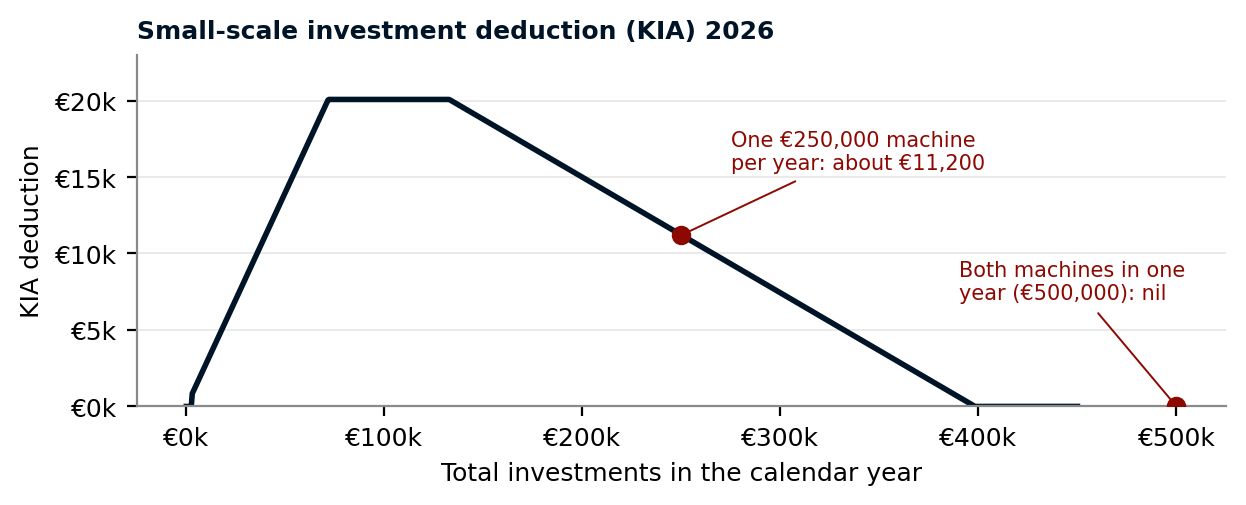
The small-scale investment deduction (KIA) is calculated on the total amount invested in a calendar year. For 2026 the deduction is 28% for total investments between €2,900 and €71,683 and a fixed €20,072 between €71,683 and €132,746. Above that amount the deduction decreases, and above €398,236 no deduction is available. If two machines of €250,000 each are bought in the same year, there is no KIA at all. If one is bought in 2026 and the other in 2027, the deduction is about €11,200 in each year. Check the expected total for 2026 before committing to further investments in December.
The energy investment deduction (EIA) is proposed to increase from 40% to 45.5% as of 1 January 2027, so postponing a qualifying energy investment to January can be beneficial. EIA, MIA and Vamil investments must be reported within three months after the commitment is entered into. For all these deductions, the year in which the commitment is entered into determines the year of the deduction; postponing only payment or the invoice does not change this.
In the last VAT return of 2026, input VAT on staff benefits and business gifts must be corrected if the benefit per employee or relation exceeded €227 in 2026. For cars on which VAT was deducted, a correction for private use is required, and commuting counts as private use for VAT purposes. Businesses with both taxed and exempt supplies must check whether input VAT on investment goods needs to be revised.
By decree of 2 July 2026, the state secretary ended the approval under which road tax passed on by a leasing company was treated as a pass-through item. From 1 January 2027 leasing companies must charge VAT on the road tax included in the lease, which increases costs for businesses that cannot fully recover VAT. In some cases this can be avoided by registering the car in the name of the lessee.
Sole traders
14. Should a sole proprietorship move into a BV in 2026?
Several deductions for sole traders are reduced. The self-employed deduction decreases from €1,200 in 2026 to €900 in 2027. The starters’ deduction is reduced to €10 in 2027 and abolished in 2028. The cessation deduction on a taxable transfer of the business to a BV decreases from €3,630 to €908.
If a transfer to a BV was already planned, this is a reason to complete it in 2026. A BV that makes a fossil-fuel car available before 1 January 2027 also falls under the transitional rules described in point 10; a BV incorporated in 2027 does not, even if the business is transferred to it with retroactive effect to a date in 2026. Incorporation requires a notarial deed, so a decision should preferably be made in November.
Deadlines for everyone
15. Annuity premiums (lijfrente) before 31 December 2026
Annuity premiums (lijfrente) paid on or before 31 December 2026 are deductible in box 1 for 2026 within the annual margin. Unused margin from the previous ten years can be added. The payment also reduces box 3 assets on 1 January 2027. It is proposed not to index the maximum income for pension and annuity accrual for the years 2027 to 2032, which limits the growth of the annual margin in the coming years.
16. Last chance to claim a 2021 income tax refund
Taxpayers who were not required to file a 2021 income tax return but are entitled to a refund, for example because of withheld wage tax or unclaimed deductions, must file the return before 1 January 2027. A request for ex officio reduction of a 2021 assessment is subject to the same five-year period.
Frequently asked questions
Most measures take effect on 1 January 2027. The Lower House votes on 12 November 2026 and the Senate is scheduled to vote on 15 December 2026. The box 2 and box 3 changes announced on 29 September are part of a separate amendment to the box 3 bill, which must be adopted before 31 December 2026.
From 1 January 2027 the maximum tax-free allowance falls from 30% to 27%, except for employees whose ruling was first applied in 2023 or earlier. For employees who started in 2025 or 2026, the higher salary threshold applies from 2027.
The option ends on 31 December 2026 for everyone. From 1 January 2027 the taxpayers concerned are taxed in box 3 on their worldwide savings and investments and in box 2 on shareholdings of 5% or more in foreign companies.
Yes. Residents of the Netherlands are taxed in box 3 on their worldwide assets, valued in euros on 1 January. For foreign real estate, relief for double taxation is generally available. For foreign savings and portfolio investments it generally is not.
Under the proposals of 29 September 2026, the tax-free allowance (heffingsvrij vermogen) would be €30,846 per person, compared with €59,357 in 2026. The cabinet has said it will adjust this proposal, so the final amount for 2027 is not yet known.
In most cases, a dividend up to the first box 2 bracket (€68,843 per person) is best paid in 2026 and any further amount in 2027. The higher box 2 rate is proposed to fall from 31% to 29.2% for the years 2027 to 2030.
Finally
Several figures in this overview will only be final after the Senate vote on 15 December. Waiting for that vote is often not practical: only about two weeks then remain, and notaries, banks and payroll providers are busy at year-end. Where a decision does not depend on the outcome, we recommend acting now, especially for matters that require preparation, such as a notary appointment, a Wtta registration or a gift.
We will update this overview after the vote in the Lower House. For questions about your own situation, please contact Port Sight Tax B.V., Nieuwe Plantage 54, 2611 XK Delft, portsighttax.com.
About the author
Richard Bierlaagh is Tax Partner at Port Sight Tax in Delft and Lecturer at Vrije Universiteit Amsterdam.
This overview reflects the proposals as of 27 October 2026 and contains general information, not advice for a specific situation.
Frequently asked questions about this topic
Written by:

Richard Bierlaagh
Tax Partner
Richard has been active in the tax world for over 10 years. With experience at Big Four offices and active as an author.
Get in touch
Free Consultation
Want to know more about this topic? Book a free consultation with one of our specialists.
Book an appointment
Takes just a minute